Coefficient of Friction Testing for Medical Devices and Catheters
In medical devices, friction is a patient safety parameter. A catheter with excessive surface friction resists advancement through tortuous vasculature, increasing the risk of vessel injury and procedure time. A syringe with stiction in its plunger delivers an uncontrolled bolus when the operator finally overcomes the breakaway force. Hydrophilic coatings on guidewires and catheters are specifically engineered to reduce COF to below 0.05 in wet conditions, and coating uniformity must be validated batch-by-batch before release. KHT covers medical device friction testing with two different instruments: the MXD-02A Coefficient of Friction Tester, configured with custom fixtures and a high-resolution load cell, for flat materials such as gloves, drapes, and packaging; and the XLW-DG Catheter & Guidewire Friction Tester, a dedicated wet-condition clamp-and-pull instrument built specifically for round, flexible devices such as catheters and guidewires.
Quick Answer
COF testing for medical devices measures the force required to move a device surface against a tissue-simulating or metal counter-surface under physiologically relevant load conditions. For catheter and guidewire testing, wet COF (in saline or water at 37°C) is typically measured using custom fixtures that simulate the lumen geometry. Results validate coating efficacy, guide formulation optimization, and support regulatory submissions as evidence of device performance consistency.
Why COF Matters for Medical Devices
Friction in medical devices affects three outcomes: patient safety, procedural success, and regulatory compliance. For interventional catheters and guidewires, low surface COF in wet conditions allows navigation through narrow, curved anatomy without kinking or vessel damage. For urinary catheters and nasogastric tubes, insertion COF directly affects patient discomfort and injury risk — friction force above a threshold causes mucosal trauma even with careful insertion technique. For syringes and auto-injectors, plunger friction (stiction and breakaway force) must be controlled within tight limits to ensure accurate dose delivery and smooth activation. For implantable devices with moving articulating surfaces — joint replacement trial components, spinal instrumentation — COF data supports wear and lubrication performance claims in regulatory filings.
Catheter Surface Friction Testing
For dedicated, wet-condition catheter and guidewire friction testing, KHT's XLW-DG Catheter & Guidewire Friction Tester is the purpose-built instrument: an integrated thermostatic water bath conditions the sample, silicone clamp pieces hold it at a set gap and clamping force, and the device is pulled through the clamp while force is recorded — the clamp-and-pull (pinch test) method the catheter industry actually uses, rather than the flat-sled method built for film and sheet. See the XLW-DG product page for full specifications.
Some labs also run catheter or tubing friction as a secondary test on the MXD-02A, using its accessory fixture mounting points: a custom channel fixture clamps the catheter in a straight section, applies a defined normal force (set by the sled weight or spring load), and the instrument pulls the platen at the specified speed while recording the friction force. Both dry and wet (submersion or wet-sponge) configurations are used. This MXD-02A fixture approach is a workaround for labs that already standardize on MXD-02A for other flat-material testing; for hydrophilic-coated devices tested wet as the primary QC method, the XLW-DG's built-in thermostatic bath is the more direct fit.
Hydrophilic Coating Validation
Hydrophilic coatings — based on polyvinylpyrrolidone (PVP), polyethylene oxide (PEO), or polyurethane chemistry — create a water-swollen lubricious layer that can reduce catheter surface COF from 0.4–0.8 (uncoated) to below 0.05 in wet conditions. Coating validation requires measuring COF at multiple points along the device length (proximal, mid, and distal), across multiple batches, and after exposure to relevant use conditions (number of insertion cycles, time in saline, aging). The MXD-02A's software supports repeated sequential tests on the same specimen to capture COF drift during simulated use cycles. Critical-to-quality limits for hydrophilic coatings are typically defined as maximum wet COF (e.g., <0.10) and minimum wet-dry COF ratio (e.g., >70% reduction from dry), both verifiable with the MXD-02A friction test output.
Custom Fixture Design for Medical Applications
Standard film and paper sled configurations are not appropriate for most medical device geometries. KHT's applications team designs custom fixtures for the MXD-02A that accommodate the specific geometry of each device type. For cylindrical devices (catheters, tubing, guidewires), a v-groove or half-pipe channel fixture supports the device and defines the contact length and normal load. For flat devices (pouches, drapes, suture packaging), the standard platen configuration applies. For articulating joints or implant trial inserts, a flat-on-flat or convex-on-flat fixture replicates the articular geometry. Custom fixtures are manufactured to bolt onto the MXD-02A base plate using the standard T-slot mounting system, requiring no instrument modification. Fixture engineering time is typically 2–4 weeks; KHT ships documented fixtures with calibration records.
Regulatory Requirements and Documentation
Medical device manufacturers operating under ISO 13485 quality systems and submitting to FDA or CE regulatory authorities must demonstrate that friction-critical performance attributes are controlled. Customers use COF data measured on the MXD-02A as objective evidence within their own 510(k) submissions and CE Technical Files, showing that the device performs within its labeled friction specification — the MXD-02A is laboratory test equipment, not a medical device, so it is not itself subject to 510(k) clearance, and KHT makes no regulatory claim on the customer's behalf. The MXD-02A generates PDF test reports with instrument identification, calibration status, test parameters (speed, sled weight, load cell range), and calculated static and kinetic COF with individual readings and statistical summary — the complete documentation trail required for a Design Verification record. All data is also exported in CSV format for import into QMS or risk management databases. Calibration certificates with traceability to national standards are supplied and renewed annually.
Case Study: Anti-Blocking Performance on Powder-Free Surgical Gloves
Powder-free nitrile surgical gloves rely on chlorination or polymer coating to lower the inner-surface friction enough to prevent blocking inside sterile packaging and to allow smooth, dry donning under operating-room time pressure. The friction window is narrow — too little surface treatment and gloves block in the pouch; too much and the rubber prematurely ages or develops uneven wear. Friction is the only practical online indicator of treatment uniformity. In a representative test on a size 7.5 chlorinated nitrile glove, inner-versus-inner specimens were cut to 80 × 200 mm (table) and 100 × 63 mm (sled wrap) and run on the MXD-02A at 200 g sled weight, 100 mm/min, with a 15-second static dwell to simulate folded contact in the pouch. Across three replicates the mean static COF was 0.266 and mean kinetic COF was 0.258, with static-COF range of 0.008 and kinetic-COF range of 0.012 — extremely tight scatter. A μk below 0.30 confirms effective anti-blocking treatment; the small replicate-to-replicate range confirms uniform chlorination across the batch. The same protocol catches under-chlorinated batches (μk > 0.35) and over-chlorinated batches (rubber stiffening that shows up as elevated μs). Note: the MXD-02A's demagnetized stainless platen suppresses the static-charge effects that otherwise distort small-force measurements on flexible rubber materials.
Recommended KHT Model for Medical Device Testing
For catheters and guidewires — including hydrophilic-coated devices tested wet — the primary recommendation is the XLW-DG Catheter & Guidewire Friction Tester. Its integrated thermostatic water bath and clamp-and-pull method match how the industry actually tests finished catheters and guidewires, and it is built to run YY/T 1536-2017 and T/CAMDI 021-2019. For flat medical materials — gloves, drapes, sterile packaging, and pouch/lidding laminates — the recommendation is the MXD-02A — Export Flagship. The base-plate-drag mechanism isolates the load cell from drive vibration — critical when measuring coating friction where differences of 0.01 units distinguish acceptable from defective coatings. The demagnetized stainless steel test platen suppresses static-charge artifacts that otherwise corrupt small-force readings on flexible rubber gloves, latex sheet, and silicone sheet. Sample thickness up to 10 mm accommodates folded glove layers. Choose MXD-02 — Multi-Standard Pro (with 30 N load cell) for syringe plunger stiction studies where forces routinely reach 10–15 N. MXD-01 / MXD-01A are not recommended for medical device QC due to limited standard coverage and the small-force performance gap vs. MXD-02A. See XLW-DG, MXD-02A, or compare all 4 MXD models.
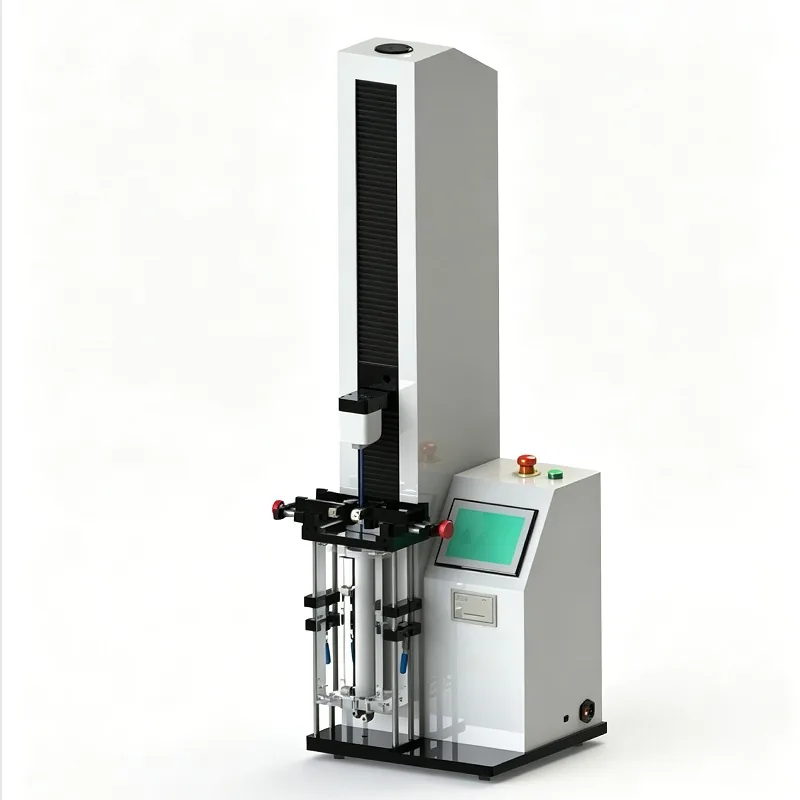
Recommended for Catheters & Guidewires
XLW-DG Catheter & Guidewire Friction Tester
Wet-condition clamp-and-pull (pinch test) method with an integrated thermostatic water bath — built to YY/T 1536-2017 and T/CAMDI 021-2019 for hydrophilic-coated devices.
View XLW-DG →Frequently Asked Questions
Need a Medical Device Friction Tester?
COF testing for catheters, guidewires, and medical tubing surfaces — tell us your requirements and we respond within 24 hours.