MXD-02 Coefficient of Friction Tester — Multi-Standard Pro
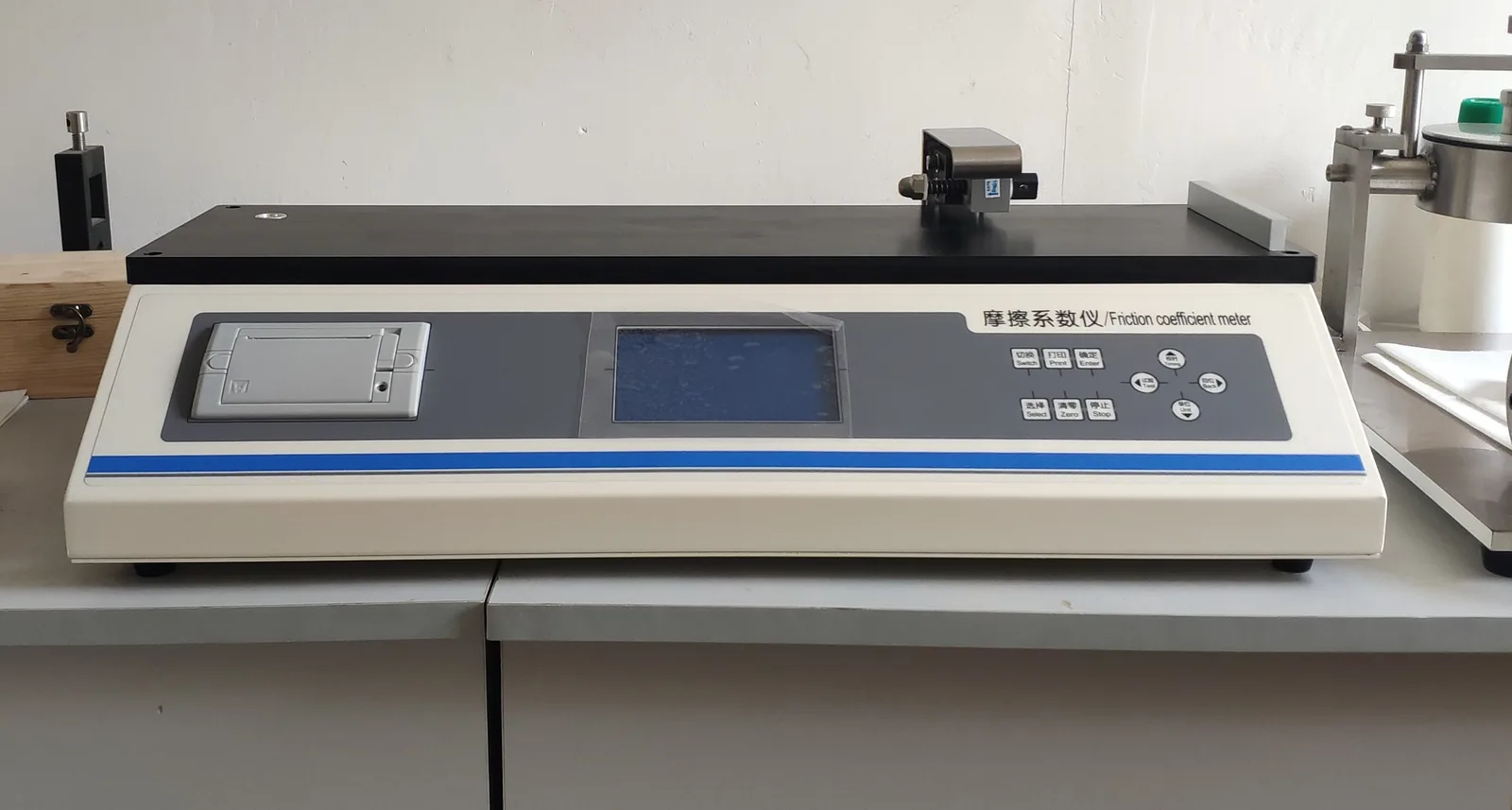
The KHT MXD-02 is a multi-standard coefficient of friction tester with all four major international friction standards — GB 10006, ISO 8295, ASTM D1894, and TAPPI T816 — pre-loaded as one-touch hardware presets, requiring no parameter entry from the operator. Its variable speed range of 1 to 1200 mm/min is the highest available on any standard-format COF tester and directly satisfies the 20 mm/s (1200 mm/min) requirement of the paper industry's GB/T 22895 standard, which most competing instruments cannot reach. Both the 200 g and 500 g sleds are included as standard equipment.
Quick Answer
Choose the MXD-02 when your lab must run all four major COF standards — GB 10006, ISO 8295, ASTM D1894, and TAPPI T816 — as one-touch presets, with no manual parameter entry. Its 1 to 1200 mm/min variable speed uniquely covers the paper industry's GB/T 22895 high-speed requirement that most instruments cap at 500 mm/min. The MXD-02 is the preferred model for paper mills, paperboard manufacturers, and multi-standard QC labs where standard-switching speed and completeness matter more than touchscreen UX or ultra-thin-film accuracy.
What Makes the MXD-02 Different
Two features separate the MXD-02 from every other COF tester in the KHT lineup and from most instruments in its category. First, all four internationally recognized friction standards are pre-loaded as dedicated one-touch hardware presets: GB 10006, ISO 8295, ASTM D1894, and TAPPI T816. No other current KHT model includes TAPPI T816 as a preset — on the MXD-02A, TAPPI parameters must be entered manually into the custom mode each time. On the MXD-02, selecting TAPPI T816 is a single button press that instantly loads the correct speed, sled mass, and stroke. For paper and paperboard labs that run TAPPI T816 daily alongside the other standards, this eliminates an entire category of setup error and cross-contamination between test methods.
Second, the MXD-02 supports test speeds up to 1200 mm/min in its variable speed range. This is the highest speed rating of any current KHT model. Most competitors in this class top out at 500 mm/min, which is insufficient for GB/T 22895, China's national standard for the friction coefficient of paper and board in high-speed transport and printing applications. GB/T 22895 specifies a test speed of 20 mm/s, which equals exactly 1200 mm/min. The MXD-02 reaches this speed; the MXD-02A (maximum 500 mm/min) does not. For paper and converting facilities where GB/T 22895 compliance is required, the MXD-02 is the only KHT model that qualifies.
Detailed Technical Specifications
The MXD-02 uses a sled-drag drive mechanism: the motor drives a cable or belt connected to the sled, pulling it across the stationary sample table at the selected speed. The load cell is positioned at the sled attachment point and measures the lateral pull force throughout the test. This is the conventional horizontal-plane COF tester architecture and is directly compliant with the drive method described in all four built-in standards.
The standard load cell spans 0 to 5 N with a resolution of 0.001 N and a force accuracy of 0.5% FS. Optional load cell ranges of 10 N and 30 N are available for higher-friction materials. Test speed is selectable between two standard-compliant presets — 100 mm/min (ISO 8295 and GB 10006) and 150 mm/min (ASTM D1894 and TAPPI T816) — and additionally across a variable range of 1 to 1200 mm/min for non-standard or high-speed paper testing per GB/T 22895. Stroke length defaults to 70 mm or 150 mm and is configurable from 1 to 320 mm for custom applications.
Sample thickness capacity is 0 to 6 mm, covering the full range of plastic films, papers, and paperboard substrates. Instrument dimensions are 630 × 300 × 180 mm at a net weight of 20 kg — notably lighter and more compact than the MXD-02A — making it straightforward to move between laboratory benches or to ship as checked laboratory equipment. Power supply is AC 220 V 50 Hz standard; 110 V supply is available with a transformer option.
Why Paper Industry Labs Choose MXD-02
The paper and paperboard industry imposes friction testing requirements that most general-purpose COF testers cannot fully satisfy. Three specific demands drive instrument selection in paper mills, tissue converters, and graphic arts facilities.
The first is TAPPI T816 as a preset. TAPPI T816 (Coefficient of Static Friction of Corrugated and Solid Fiberboard) is the dominant friction standard in North American paper and packaging, and is widely adopted alongside ISO standards in European converting facilities. Labs that run TAPPI alongside ISO 8295 and ASTM D1894 need single-button preset switching to maintain throughput in multi-standard QC environments. The MXD-02 is the only KHT model that provides TAPPI T816 as a one-touch preset.
The second demand is high-speed capability. GB/T 22895 — the Chinese national standard for the friction coefficient of paper and board under transport and printing conditions — specifies a test speed of 20 mm/s (1200 mm/min). This speed is beyond the mechanical limits of most COF testers, including the MXD-02A (500 mm/min maximum). The MXD-02 reaches 1200 mm/min in its variable speed range, making it the qualifying instrument for facilities that must demonstrate GB/T 22895 compliance.
The third demand is that both the 200 g and 500 g sleds are included, since paper and paperboard testing sometimes requires the heavier 500 g sled to simulate stacking pressure in pallet or warehouse conditions. The MXD-02 includes both sleds as standard equipment at no additional cost.
All Four Standards Built In
The four pre-loaded friction standard presets in the MXD-02 cover the complete international landscape of COF testing for films, paper, and packaging:
GB 10006 is China's national standard for the determination of static and kinetic friction coefficients of plastic films and sheets. The preset loads 100 mm/min test speed, 200 g sled, and the GB-specified calculation method.
ISO 8295 (Plastics — Film and Sheeting — Determination of the Coefficients of Friction) covers the same substrate class internationally. The preset applies 100 mm/min and 200 g sled per the primary ISO method.
ASTM D1894 (Standard Test Method for Static and Kinetic Coefficients of Friction of Plastic Film and Sheeting) is the dominant standard in North American film and packaging. The preset loads 150 mm/min and 200 g sled. The MXD-02 includes three built-in ASTM D1894 sub-modes corresponding to the standard's different measurement configurations.
TAPPI T816 (Coefficient of Static Friction of Corrugated and Solid Fiberboard) is the North American paper and packaging industry's primary friction standard. The preset applies 150 mm/min and 200 g sled per TAPPI's method specifications.
A fifth custom mode accepts arbitrary speed (1–1200 mm/min), sled mass, and stroke values for non-standard or internal QC test protocols. All five modes — four standards plus custom — are accessible via the film-keypad controls on the 5-inch LCD panel.
Sled Options — 200 g and 500 g Included
Unlike the MXD-02A, where only the 200 g sled is included as standard and the 500 g is an optional upgrade, the MXD-02 ships with both sleds as part of the standard package at no additional cost. This is a deliberate product decision recognizing that paper and paperboard testing frequently requires both.
The 200 g sled with a 63 × 63 mm base meets the geometry specified in ASTM D1894, ISO 8295, GB 10006, and TAPPI T816 for the standard reference-surface contact conditions. It is the correct sled for all routine COF measurements on plastic films, coated papers, and laminates.
The 500 g sled applies a higher normal force and is used in two scenarios: testing substrates where ASTM D1894 or a custom method specifies the heavier weight, and simulating elevated-normal-force contact conditions such as stacked cartons, pallet layers, or high-tension winding applications. Having both sleds in hand from day one avoids procurement delays and allows multi-sled method comparison without waiting for accessories.
Custom sled geometries are available to order separately for applications requiring specific contact areas, surface materials, or geometric shapes not covered by the standard 63 × 63 mm square base. Provide contact-area dimensions or a sketch with the inquiry and KHT will confirm manufacturing feasibility and pricing.
Software and Computer Connection
The MXD-02 includes dedicated PC control software as standard, delivered on USB. The software connects to the instrument via a USB cable and provides a full-featured graphical interface on the connected PC: test parameter setup, real-time force-versus-displacement curve display, automatic static and kinetic COF calculation, and multi-specimen batch statistics.
Batch statistics output includes mean, standard deviation, coefficient of variation (CV%), minimum, and maximum across any run size. Results can be exported as formatted reports or as CSV files for integration with laboratory information management systems or spreadsheet-based quality management workflows.
The 5-inch LCD panel on the instrument itself, controlled via film-keypad buttons, provides the local operator interface for standard selection, parameter display, and immediate result readout without a connected PC. This makes the instrument functional as a standalone unit in production environments where a computer at the test station is impractical, while the PC software handles full data management and reporting when a workstation connection is available.
A built-in mini thermal printer provides immediate hard-copy output of individual test results directly at the instrument, without requiring a PC connection or network access. This is particularly useful in production floor QC positions where paper records accompany each tested lot.
How to Order and Lead Time
The MXD-02 ships as a complete package: instrument, 200 g sled, 500 g sled, PC software on USB, mini printer, USB cable, power cord, and English operation manual. The primary configuration decision at order time is load cell range: 5 N standard, 10 N, or 30 N for higher-friction materials. Stroke length (70 mm or 150 mm standard preset, or 1–320 mm custom) and any custom sled geometry requirements should also be specified.
For facilities requiring 110 V power supply, a step-down transformer option is available and must be specified at the time of order. Confirm your facility's power supply before ordering.
Submit a quote request through the contact form on this site or email info@coefficientoffrictiontester.co with your configuration requirements. A KHT technical sales engineer will respond within one business day with a detailed quotation.
Standard lead time from confirmed purchase order to crated FOB Qingdao shipment is 3 to 5 weeks. Export crating uses IPPC ISPM 15 fumigated wooden packaging accepted at all major customs authorities. Air freight from Qingdao delivers to most destinations in North America, Europe, and Southeast Asia within 3 to 5 business days. Sea freight LCL is available for multi-unit or budget-sensitive orders. A factory calibration certificate is included with every unit, documenting multi-point load cell verification against traceable reference weights.
Frequently Asked Questions
Need TAPPI T816 + High-Speed Paper Testing?
MXD-02 ships with all four standards as one-touch presets plus 1200 mm/min high-speed mode. Tell us your paper-industry requirements and we respond within 24 hours.