MXD-01A Coefficient of Friction Tester — Touchscreen Entry Model
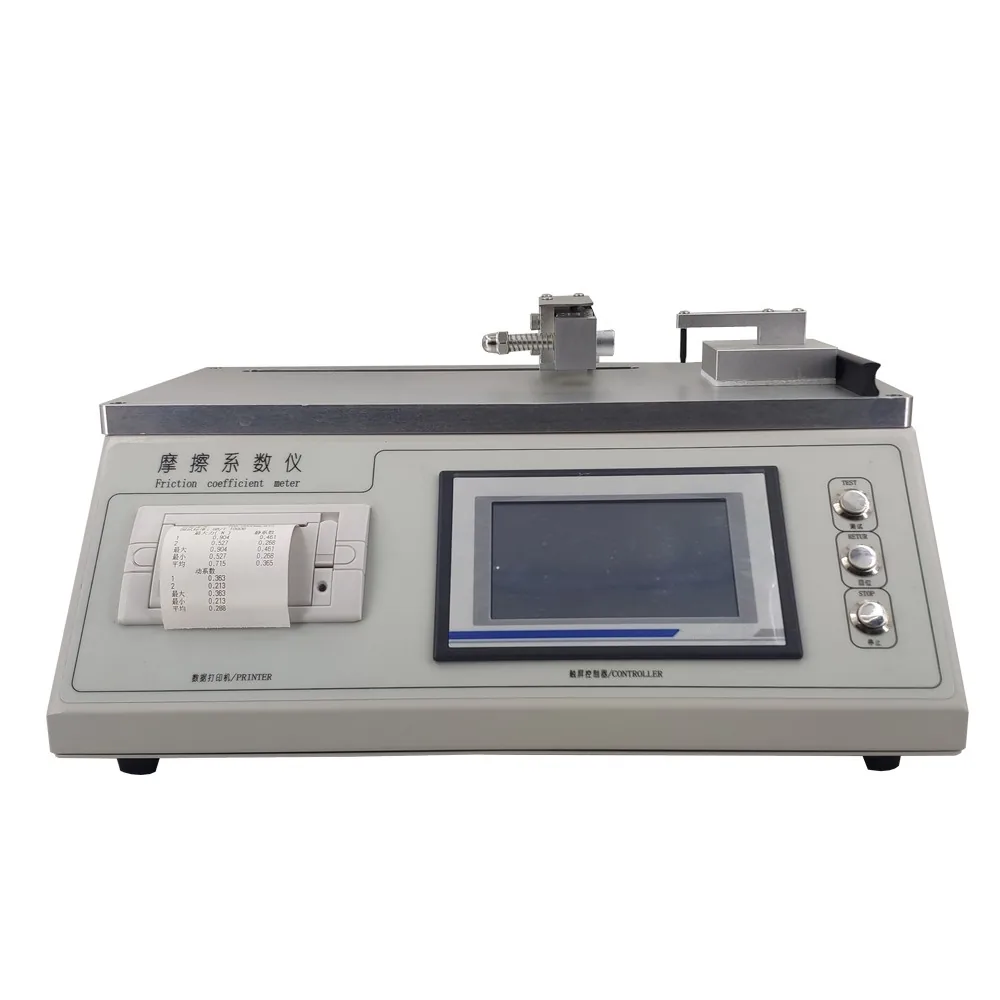
The KHT MXD-01A is an entry-level coefficient of friction tester built around a 5-inch color touchscreen with bilingual Chinese/English interface and a 90–240 V universal power supply — making it the most export-ready instrument in the entry-tier range. It covers GB 10006 and ASTM D1894 using the traditional sled-drag mechanism, delivering 0.001 N resolution and 0.5% FS accuracy on a standard 5 N load cell. Priced for routine packaging-film QC labs and training facilities that want a modern touchscreen experience without stepping up to a multi-standard platform.
Quick Answer
Choose the MXD-01A if you need GB 10006 and ASTM D1894 compliance in an entry-level instrument with a touchscreen interface. The 5-inch color display with bilingual CN/EN UI reduces operator training time, and the 90–240 V universal power supply means it ships and runs anywhere in the world without a step-down transformer. If you also need ISO 8295 or TAPPI T816 presets, or a variable test speed, step up to the MXD-02 or MXD-02A.
What Makes the MXD-01A Different
The MXD-01A occupies a specific niche in the KHT lineup: it shares the same physical dimensions, sled geometry, force range, and standards coverage as the MXD-01, but delivers two meaningful upgrades that change the day-to-day operating experience.
First, the display is a 5-inch color touchscreen with a bilingual Chinese/English interface. The operator can switch the UI language in a single tap — no reconfiguration or separate firmware build required. This is meaningful for export buyers who receive Chinese-manufactured instruments but run an English-language lab, or for training environments where instructors move between both languages.
Second, the power supply is rated 90–240 V universal at 50/60 Hz, covering the full global voltage range without external transformation. The MXD-01A plugs into a standard outlet in North America (120 V/60 Hz), Europe (230 V/50 Hz), Japan (100 V/60 Hz), or anywhere in between. The MXD-01, by contrast, is fixed at 220 V/50 Hz and requires a step-down transformer in most markets outside China. For international buyers, this is not a cosmetic difference — sourcing, sizing, and maintaining a step-down transformer adds cost and a failure point.
Beyond these two upgrades, the MXD-01A uses the traditional sled-drag mechanism common to both entry-level models: the test platform is stationary and the sled is pulled across the specimen by a lead-screw drive. This is a proven, low-maintenance geometry that is fully sufficient for the two-standard scope (GB 10006 and ASTM D1894) the instrument is designed to cover.
Detailed Technical Specifications
The MXD-01A is built around a standard 0–5 N strain-gauge load cell with 0.001 N digital resolution and 0.5% FS force accuracy across the full working range. At 5 N full scale, 0.5% FS corresponds to a maximum error of 0.025 N — sufficient to distinguish meaningful differences in friction treatment levels on packaging films.
Test speed is pre-set at two values: 100 mm/min and 150 mm/min. These cover the two primary standard speeds — 100 mm/min for GB 10006 and 150 mm/min for ASTM D1894 — selected via the touchscreen menu. Speed is not continuously variable; if a custom intermediate speed is required, the MXD-02A is the appropriate model. Stroke length is selectable between 70 mm and 150 mm.
The standard 200 g sled measures 63 × 63 mm in contact area, meeting the ASTM D1894 sled geometry requirement. Sample thickness capacity is 0–6 mm. Instrument dimensions are 400 × 300 × 180 mm (W × D × H) and net weight is approximately 15 kg, consistent with placement on a standard laboratory bench without additional infrastructure.
Power supply: 90–240 V AC, 50/60 Hz — universal. The instrument includes a mini thermal printer for on-site hard-copy output, a power cable, and an operator manual. USB connectivity is provided for data transfer to a PC.
The MXD-01A uses a sled-drag mechanism (stationary test platform, moving sled). The test table is ground flat and demagnetized stainless steel to minimize surface-induced measurement error.
Display and User Interface
The defining hardware feature of the MXD-01A is its 5-inch color touchscreen. Compared to the film-keypad button controls on the MXD-01, the touchscreen changes the operating workflow in practical ways.
Operators navigate the test menu by tapping directly on on-screen fields rather than cycling through keypad presses. Standard selection (GB 10006 vs. ASTM D1894), speed selection (100 mm/min vs. 150 mm/min), stroke selection, and batch size entry are all touch inputs. The real-time force trace is displayed on the same screen during the test, giving the operator immediate visual feedback without a separate monitor or PC.
The bilingual interface stores both Chinese and English UI strings on the controller. Language switching is a one-tap operation accessible from the settings screen — no rebooting, no firmware reflash. This is particularly valuable in two scenarios: when the instrument ships from a Chinese factory to an English-language end user, and when the instrument is used in a training context where both languages are in regular use.
The built-in mini thermal printer outputs a hard-copy test record showing the specimen ID, test standard, speed, static COF, kinetic COF, force curve trace, and ambient conditions. For labs that need formatted PDF or CSV output, USB connectivity links the MXD-01A to a PC running the included software. The MXD-02 and MXD-02A offer a 5-inch LCD (02) or 8-inch touchscreen (02A) with additional standard presets if a larger display or more test methods are needed.
Standards Coverage
The MXD-01A is pre-configured for two test standards: GB 10006 (the Chinese national standard for friction coefficient measurement of plastic films and sheets) and ASTM D1894 (Standard Test Method for Static and Kinetic Coefficients of Friction of Plastic Film and Sheeting, ASTM International).
GB 10006 specifies 100 mm/min test speed, a 200 g sled, and the horizontal plane sled method. It is the primary compliance reference for packaging film manufacturers supplying the domestic Chinese market. ASTM D1894 specifies 150 mm/min and the same 200 g sled geometry, and is the dominant friction standard cited in purchase specifications by North American, European, and Southeast Asian packaging buyers.
The MXD-01A does not include ISO 8295 (the European/ISO equivalent of D1894) or TAPPI T816 (the paper industry standard) as factory presets. For labs that need ISO 8295 compliance, the MXD-02 or MXD-02A includes this standard as a one-touch preset. For labs testing paper and paperboard under TAPPI T816, the MXD-02 is the minimum appropriate model.
In practice, a significant majority of packaging film friction tests are conducted under either GB 10006 or ASTM D1894, or both. For labs whose entire workflow falls within these two standards, the MXD-01A delivers fully compliant results at entry-level cost. The 200 g sled supplied with the MXD-01A is the correct sled for both GB 10006 and ASTM D1894 without substitution.
Best-Fit Applications
The MXD-01A is best suited for three distinct use cases.
First, routine packaging-film QC in facilities that test primarily against GB 10006 and ASTM D1894. The two preset speeds cover both standards, the touchscreen reduces per-operator training time, and the built-in thermal printer provides on-the-floor test records without a PC. Production QC labs running five to twenty specimens per day in a single standard will find the MXD-01A operationally complete.
Second, international labs and distributors receiving instruments from China. The 90–240 V universal power supply eliminates the transformer procurement problem that accompanies the MXD-01 in non-220 V markets. An overseas buyer can receive the MXD-01A, plug it in, switch the UI to English, and be operational within minutes of uncrating.
Third, training facilities, technical schools, and university labs introducing students to friction measurement. The touchscreen UI with a bilingual display is more intuitive for new users than a button keypad, and the lower cost versus the MXD-02 or MXD-02A is appropriate when the primary purpose is pedagogical rather than multi-standard production testing.
The MXD-01A is not the recommended choice when ISO 8295 or TAPPI T816 compliance is required, when the test speed must be set to a value other than 100 or 150 mm/min, when sample thickness exceeds 6 mm, or when a variable-speed drive is needed for research or development work.
Compare with Other KHT Models
Understanding where the MXD-01A sits in the KHT lineup requires comparing it against the three other models on specific dimensions.
Versus MXD-01: The MXD-01 has a 5-inch LCD with film-keypad button controls and a fixed 220 V/50 Hz power supply. The MXD-01A upgrades both of these: touchscreen with bilingual UI, and 90–240 V universal power. Standards coverage is identical (GB 10006 + ASTM D1894 only). Dimensions and sled geometry are the same. If voltage compatibility or touchscreen operation matters to your purchasing decision, the MXD-01A is the correct choice. If lowest possible cost is the sole criterion and 220 V is available, the MXD-01 is the alternative.
Versus MXD-02: The MXD-02 adds ISO 8295 and TAPPI T816 as factory presets (four total standards), includes a high-speed mode up to 1200 mm/min for paper industry testing, and uses a 5-inch LCD with button keypad. It is a sled-drag instrument like the MXD-01A. If your lab needs more than two standards, the MXD-02 is the step up.
Versus MXD-02A: The MXD-02A is the export flagship — it uses a base-plate-drag mechanism (different from the sled-drag of the MXD-01A), an 8-inch touchscreen, infinitely variable speed from 0.1 to 500 mm/min, and a 0–10 mm sample thickness range. If you need the precision and flexibility of the flagship, the MXD-02A is the appropriate choice. It is not an entry-level instrument.
How to Order and Lead Time
The MXD-01A ships in a standard configuration: 5 N load cell, 200 g sled (63 × 63 mm), 5-inch color touchscreen controller, mini thermal printer, power cable, and operator manual in both English and Chinese.
Load cell upgrades are available if your materials require higher force capacity — contact KHT to confirm the appropriate range for your specific application before ordering. The standard 200 g sled is correct for GB 10006 and ASTM D1894 testing as described above.
To request a quotation, submit a request via the quote form at info@coefficientoffrictiontester.co. Standard information needed: quantity, destination country, and any non-standard load cell or accessory requirements. Quotations are returned within 24 hours.
Standard lead time is 3–5 weeks from confirmed purchase order to crated shipment, FOB Qingdao. Packaging meets IPPC ISPM 15 phytosanitary requirements for fumigated wood crating, accepted in all major import markets. Air freight from Qingdao delivers to most destinations within 3–5 business days. Sea freight is available for multi-unit or budget-sensitive orders.
Every MXD-01A ships with a calibration certificate traceable to national measurement standards. The warranty period is 24 months from date of shipment, covering parts and labor. Technical support is available by email and WhatsApp.
Frequently Asked Questions
Need a Touchscreen COF Tester at the Best Price?
MXD-01A delivers a modern UI and universal power for routine ASTM D1894 testing. Tell us your application — we respond within 24 hours with factory-direct pricing.