MXD-02A FLAGSHIP
MXD-02A Coefficient of Friction Tester — KHT Export Flagship
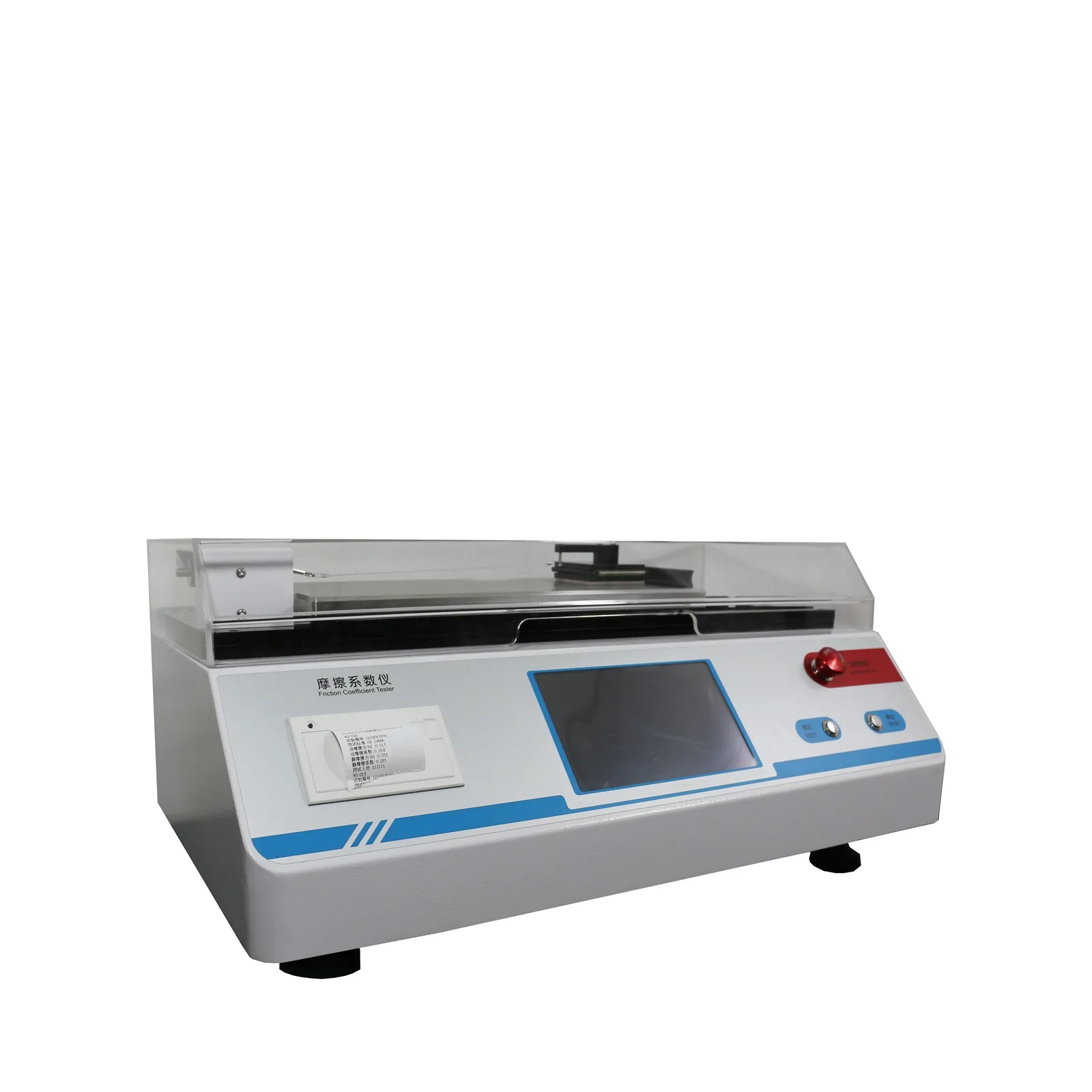
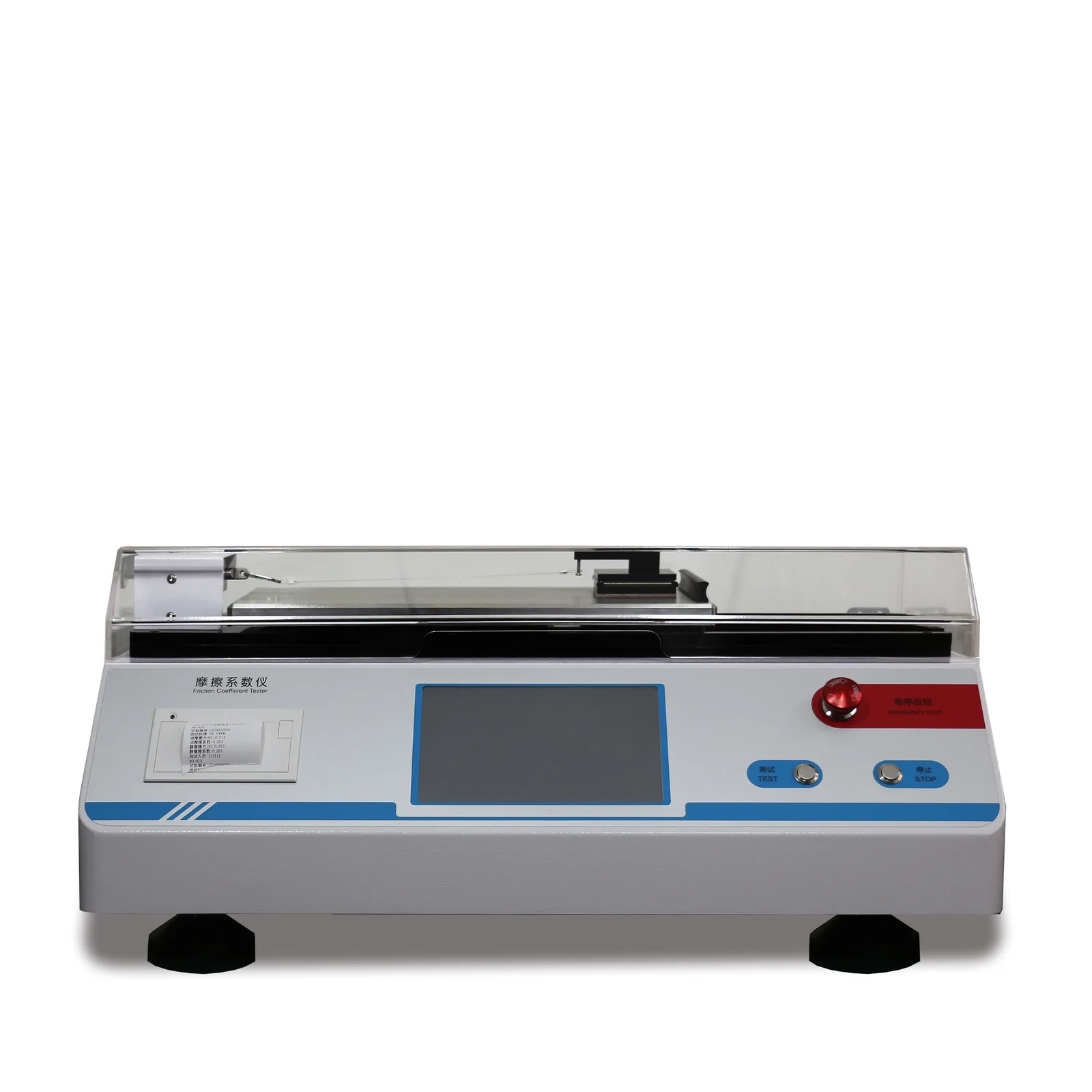
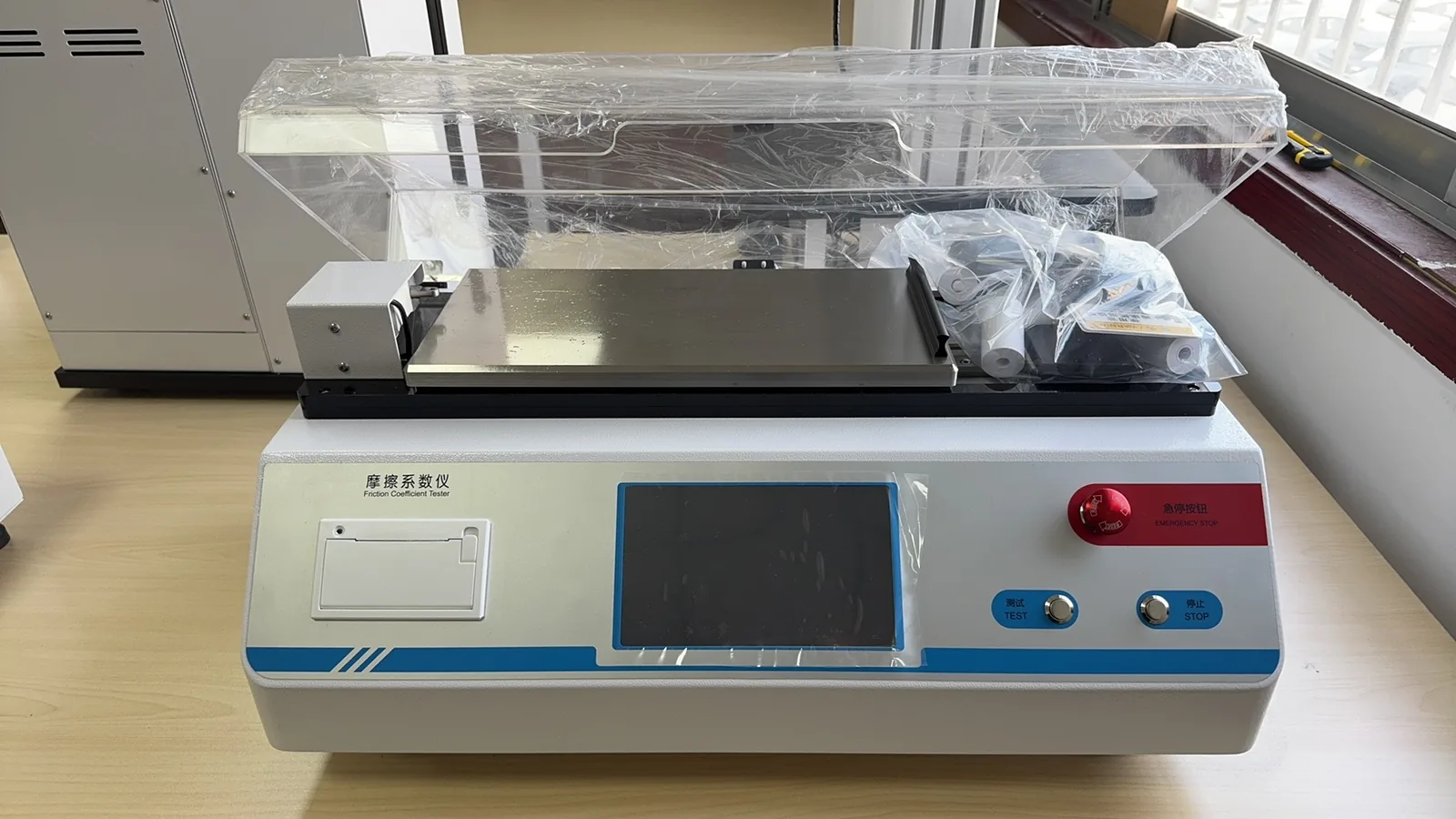
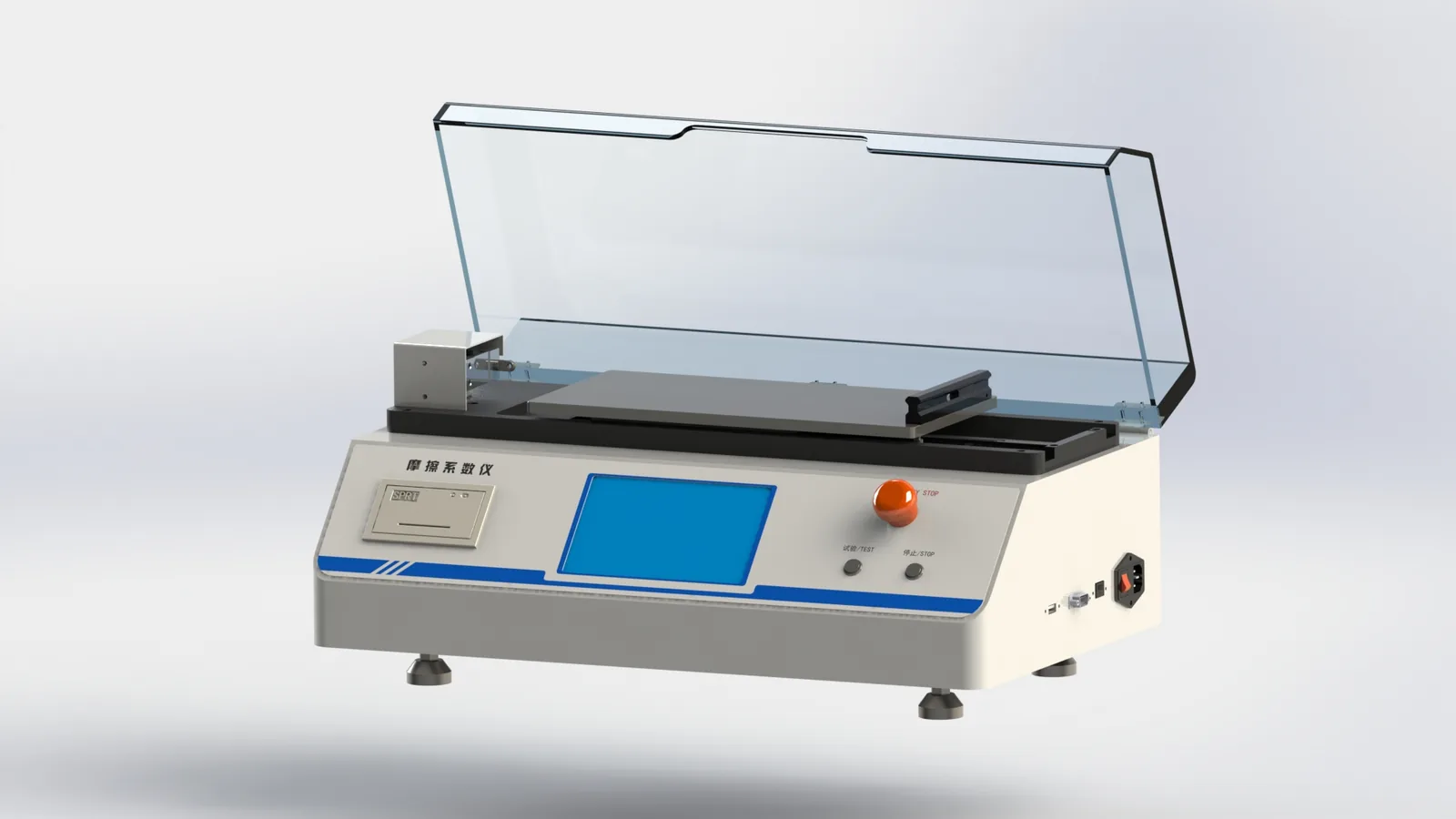
The KHT MXD-02A uses a base-plate drag mechanism — the sample table moves while the sled remains stationary — eliminating drive-induced vibration on the load cell and delivering superior accuracy on thin films and sub-1 N friction forces. An 8-inch HD color industrial touchscreen with bilingual CN/EN interface, infinitely variable test speed from 0.1 to 500 mm/min (no preset gears), and a sample thickness capacity of 0 to 10 mm make it the most versatile COF tester in the KHT lineup and the model most specified for international export markets.
Films, Paper, Rubber, Textiles, Medical, Automotive — One Platform
Unlike the traditional sled-drag mechanism most competitors use, the MXD-02A's base-plate-drag structure isolates the sensor from drive vibration — delivering measurably better accuracy on thin films and small forces. Cantilever-beam load cell with 0.5% FS accuracy, 0.1–500 mm/min infinitely variable speed, 8-inch HD color touchscreen with bilingual UI, and built-in test modes for GB 10006, ISO 8295, ASTM D1894, plus a custom mode for TAPPI T816 and lab-defined methods.
Force Range
5 N std (3/10/30 N opt.)
Force Accuracy
0.5% FS
Test Speed
0.1–500 mm/min variable
Sample Thickness
0–10 mm
Display
8" color touchscreen
Mechanism
Base-plate drag
Quick Answer
Choose the MXD-02A when you need the highest accuracy on thin films, precise work at very low forces, or infinitely variable speed for non-standard test protocols. Its base-plate drag mechanism removes the load-cell vibration inherent in sled-drag designs like the MXD-02. The 8-inch touchscreen with bilingual UI and the 0–10 mm sample thickness range make it the best fit for export-market labs and facilities that test thicker laminates, coatings, or composites alongside conventional films.
What Makes the MXD-02A Different
The defining feature of the MXD-02A is its base-plate drag mechanism. In conventional sled-drag instruments — including KHT's own MXD-02 — the drive cable or belt connects to the sled and pulls it across the stationary sample table. Any vibration introduced by the drive motor or cable transfer couples directly into the load cell, creating noise in the measured force signal.
The MXD-02A inverts this arrangement entirely. The sled sits fixed; the load cell is attached to it from a stationary anchor. The sample table itself is driven by the motor and moves beneath the sled at the selected test speed. Because the drive force never passes through the load cell, motor vibration and belt pulsation are isolated mechanically. The result is a cleaner force-versus-displacement curve, a lower noise floor, and more repeatable static COF peak identification — particularly important for thin films below 50 µm and for forces below 0.5 N where signal-to-noise ratio is most critical.
The test platform is stainless steel, surface-ground for flatness, and demagnetized to reduce electrostatic interference during testing of plastic films. An automatic zero-before-test routine and a static dwell time tracker — which pauses until the sled has made full contact with the sample surface — further improve measurement repeatability without requiring manual judgment from the operator.
Detailed Technical Specifications
The standard load cell covers 0 to 5 N with a resolution of 0.001 N and a force accuracy of 0.5% FS across the full span. The cantilever-beam load cell design is the same traceable architecture used in precision analytical balances; it provides a highly linear response that does not require nonlinearity correction in software. Optional load cell ranges of 3 N, 10 N, and 30 N are available at order time to match specific material and application requirements.
Test speed is infinitely variable from 0.1 to 500 mm/min with no mechanical detents or preset gears. Any speed within this range can be entered directly on the touchscreen, enabling direct compliance with ASTM D1894 (150 mm/min), ISO 8295 (100 mm/min), GB 10006 (100 mm/min), and any other protocol — including internal non-standard test methods used by specific industry sectors. Stroke length defaults to 70 mm or 150 mm but can be set to any value from 1 to 300 mm for custom work.
Sample thickness capacity is 0 to 10 mm, the largest clearance of any current KHT model. This accommodates single-ply films and papers through multi-layer laminates, coated boards, rubber sheets, conveyor belt cross-sections, and optical cable composite tapes. The standard sled is 200 g with a 63 × 63 mm base. A 500 g sled is optional, and custom sled geometries are available to replicate specific contact conditions. Overall instrument dimensions are 620 × 300 × 220 mm (L × W × H) at a net weight of approximately 35 kg. Power input is AC 110–220 V, 50/60 Hz wide-voltage input; other voltages can be configured to order.
Software Features and Bilingual UI
The 8-inch HD color industrial touchscreen is the primary operator interface. The display provides a real-time force-versus-displacement curve during each test, allowing the operator to immediately identify abnormal profiles — such as surface contamination, specimen wrinkles, or sled loading errors — without waiting for post-test analysis. All parameters, including test standard, speed, stroke, sled mass, and averaging window, are set directly on the touchscreen without a connected PC.
The interface supports both Chinese and English at the operator's selection, with full-menu bilingual labeling across all screens. This makes the instrument practical for export customers whose laboratory staff may not read Chinese, as well as for mixed-language facilities in Southeast Asia and the Middle East.
Three built-in standard presets — GB 10006, ISO 8295, and ASTM D1894 — load the correct speed, sled weight, and stroke automatically when selected. A custom non-standard mode allows entry of arbitrary speed, stroke, and sled parameters, enabling compliance with protocols such as TAPPI T816 by entering its specific parameters directly. Multi-level user permissions protect test parameters from accidental change in production environments. A power-loss memory function retains the last test configuration and results in the event of unexpected shutdown. The instrument includes a mini thermal printer for immediate hard-copy output of individual test results. USB connectivity links to a PC for batch data transfer and access to the optional PC statistical software, which computes mean, standard deviation, CV%, min, and max across multi-specimen runs and generates formatted reports.
Sled Options and Sample Configurations
The standard sled supplied with every MXD-02A is 200 g with a 63 × 63 mm base, matching the geometry specified in ASTM D1894 and GB 10006. The sled base material and surface condition can be specified at order time to meet the particular standard's requirements for the 'low friction' reference surface.
An optional 500 g sled is available for higher-normal-force applications — testing rubber, fabric, conveyor belting, or brake pad surfaces where the 200 g load is insufficient to generate stable kinetic friction. Custom sled geometries are engineered to order: common requests include circular-base sleds for specific ISO variants, sleds fitted with rubber facing to replicate footwear outsole contact, and rectangular sleds for testing along the machine direction of narrow films or tapes.
Sample thickness up to 10 mm is accommodated without modification, which means the same instrument can test a 12 µm BOPP film, a 3 mm rubber gasket sheet, and an 8 mm segment of optical cable composite tape in the same workday. The stainless-steel, surface-ground test platform accepts samples placed directly on it or clamped using optional textile and rubber clamping fixtures. An auto-zero function before each test corrects for any residual offset from the previous specimen, and the static dwell time tracker holds the sled in contact with the sample for a user-defined period before the drive cycle begins — ensuring the normal force has fully equilibrated before the friction measurement starts.
Standards Compliance — Built-In and Custom
The MXD-02A ships with three international friction standards pre-loaded as one-touch presets: GB 10006 (the Chinese national standard for plastic films and sheeting), ISO 8295 (Plastics — Film and Sheeting — Determination of the Coefficients of Friction), and ASTM D1894 (Standard Test Method for Static and Kinetic Coefficients of Friction of Plastic Film and Sheeting). Selecting any of these presets automatically loads the required motor speed, stroke, sled mass recommendation, and COF calculation rules — no manual parameter entry is needed for routine compliance testing.
ASTM D1894 includes three built-in test modes covering the standard's different measurement configurations, so labs that run multiple D1894 variants do not need to create custom parameter sets.
TAPPI T816 (Coefficient of Static Friction of Corrugated and Solid Fiberboard) and other industry-specific protocols are supported via the custom non-standard mode. The operator enters TAPPI T816's required speed (150 mm/min), sled mass (200 g), and stroke into the custom mode fields; the instrument then runs the test identically to its preset behavior. This approach also covers internal QC methods, packaging line simulation tests, and emerging application-specific friction protocols for sectors such as medical device coatings and automotive trim. The infinitely variable speed range of 0.1 to 500 mm/min ensures that any published or proprietary protocol can be replicated exactly.
Best-Fit Applications
The MXD-02A is optimally positioned for any laboratory where measurement accuracy at low force levels, test speed flexibility, or thick-sample capability are primary requirements.
Plastic film converters and flexible packaging manufacturers benefit most directly from the base-plate drag mechanism's low noise floor, which allows reliable discrimination between surface treatments — corona discharge levels, slip additive concentrations, or coating weights — that differ by as little as 0.05 COF units. Pharmaceutical and medical packaging labs that test blister foil, lidding film, and medical pouch laminates at forces well below 1 N also gain measurable accuracy advantages over sled-drag instruments.
The 0–10 mm sample thickness range makes the MXD-02A the correct choice for any facility that tests a mix of thin films and thicker substrates: woven bags, coated fabrics, rubber sheets, optical or communication cable composite tapes, conveyor belts, wood panels, brake pad surfaces, and footwear outsoles can all be measured without a secondary instrument. Cosmetics and personal care manufacturers testing application-surface friction for eye drops, skin creams, and lip products represent a growing application that benefits from the same low-force accuracy.
For export-market laboratories — in Europe, North America, the Middle East, and Southeast Asia — the bilingual EN/CN touchscreen removes language barriers in daily operation. The AC 110–220 V, 50/60 Hz wide-voltage input eliminates the need for a step-down transformer in North American or Japanese facilities.
How to Order and Lead Time
Configuring an MXD-02A order requires selecting four parameters: load cell range (5 N standard; 3 N, 10 N, or 30 N optional), sled set (200 g standard; 500 g optional; custom geometry on request), stroke preference (70 mm or 150 mm preset, or a custom value from 1 to 300 mm), and power supply voltage (AC 110–220 V, 50/60 Hz wide-voltage input standard; other voltages can be configured to order). Custom sled geometries should be described with a sketch or contact-area dimensions at the time of inquiry.
Submit a quote request through the contact form on this site or email info@coefficientoffrictiontester.co with your configuration requirements. A KHT technical sales engineer will respond with a detailed quotation and configuration confirmation within one business day.
Standard lead time from confirmed purchase order to crated shipment is 3 to 5 weeks, depending on current production scheduling and any custom accessory requirements. Shipment terms are FOB Qingdao. Export crating is enclosed fumigated wooden crating conforming to IPPC ISPM 15, accepted by customs authorities in all major markets. Air freight from Qingdao reaches most destinations in North America, Europe, and Southeast Asia within 3 to 5 business days. Sea freight LCL consolidation is available for budget-sensitive shipments or multi-unit orders. Every shipment includes the instrument, installed load cell, standard sled, USB cable, power cord for the destination voltage, operation manual (English), and factory calibration certificate.
Frequently Asked Questions
Ready to Specify Your MXD-02A?
Tell us your application and any custom sled requirements — we respond within 24 hours with factory-direct pricing.