MXD-01 Coefficient of Friction Tester — Button Entry Model
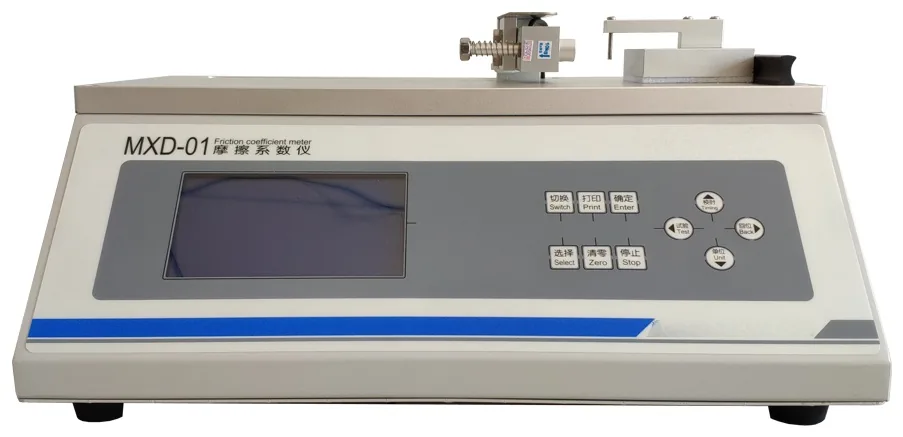
The KHT MXD-01 is the lowest-cost instrument in the KHT coefficient of friction tester family — a straightforward, no-frills entry-level platform with a 5-inch LCD and film-keypad button controls. It covers GB 10006 and ASTM D1894 using the proven sled-drag mechanism, delivering 0.001 N resolution and 0.5% FS accuracy on a standard 5 N load cell. Designed for high-volume QC labs running a single standard daily, facilities that need a cost-justified backup instrument, or buyers for whom lowest CapEx is the primary decision criterion.
Quick Answer
Choose the MXD-01 when your sole requirement is GB 10006 or ASTM D1894 compliance at the lowest possible instrument cost. The 5-inch LCD with button keypad is reliable and proven in production environments. Note that the power supply is fixed at 220 V/50 Hz — a step-down transformer is required outside 220 V markets. The language is fixed at order time (Chinese or English). If you need a bilingual touchscreen or universal voltage, upgrade to the MXD-01A. If you need additional standards, upgrade to the MXD-02.
What Makes the MXD-01 Different
The MXD-01 is distinguished from every other KHT model by a single principle: the lowest possible acquisition cost for a compliant, working coefficient of friction tester. It is not the most feature-rich instrument in the lineup — that role belongs to the MXD-02A. It is not the most export-ready — the MXD-01A's universal voltage takes that position. The MXD-01's competitive position is defined entirely by its price-to-compliance ratio.
The instrument uses a 5-inch LCD with a film-keypad membrane button interface. The operator navigates the menu by pressing physical buttons to scroll through and confirm selections. The display shows the real-time force trace, test speed, stroke progress, and calculated COF values. A built-in mini thermal printer outputs a hard-copy test record at the conclusion of each test. This combination — LCD display, button navigation, thermal print output — is the standard configuration that has served production QC labs reliably for years.
Two functional constraints distinguish the MXD-01 from the MXD-01A and should be evaluated before purchase. The power supply is fixed at 220 V/50 Hz (110 V is available as a factory option at the time of order, but is not field-switchable). In markets where mains voltage is not 220 V, a step-down transformer is required. The interface language is selected at order time — either Chinese or English is installed in the firmware, not both. There is no on-instrument language switch. Buyers who anticipate operating the instrument in both languages, or who may resell it to a user who requires a different language, should consider the MXD-01A.
Detailed Technical Specifications
The MXD-01 is built on the same metrology core used across all four KHT entry-tier instruments. The standard load cell spans 0 to 5 N with 0.001 N digital resolution and 0.5% FS force accuracy — at full scale this is a maximum error of 0.025 N, which is well within the discrimination required for packaging film slip-agent level differentiation.
Test speed is pre-set at two values: 100 mm/min (for GB 10006) and 150 mm/min (for ASTM D1894), selected via the button menu. Stroke length is selectable between 70 mm and 150 mm. The standard 200 g sled has a 63 × 63 mm contact area, satisfying the sled geometry requirements of both supported standards. Sample thickness accommodation is 0–6 mm.
Instrument dimensions are 400 × 300 × 180 mm (W × D × H) with a net weight of approximately 15 kg — the same footprint as the MXD-01A. The test table is ground flat demagnetized stainless steel.
Power supply: 220 V / 50 Hz standard. 110 V is available as a factory-configured option at the time of order — specify at ordering; this is not an in-field adjustment. The instrument ships with a mini thermal printer, power cable, and operator manual in the language specified at order. USB output is available for data transfer to a PC.
The MXD-01 uses a sled-drag mechanism: the test platform is stationary and the lead-screw drive pulls the sled across the specimen at the selected speed.
Display and User Interface
The MXD-01 uses a 5-inch monochrome or color LCD panel with a film-keypad button interface — the same general class of UI as industrial instruments in its price segment. The keypad consists of dedicated function buttons: Start/Stop, standard selection, speed selection, stroke selection, and print. Menu navigation requires the operator to press buttons sequentially to reach the desired setting, which is typical for production QC tools where operators run the same procedure repeatedly.
The LCD displays the real-time force-versus-time trace during the test, along with numeric readouts for current force, peak force (static COF event), and running mean force (kinetic COF zone). At the conclusion of the test, the controller calculates and displays the final static COF (μs) and kinetic COF (μk) values. A single button press sends the test record to the built-in mini thermal printer.
The critical constraint versus the MXD-01A is language fixity. At the time of order, the buyer specifies whether the UI should be in Chinese or English. This language is loaded in firmware at the factory and cannot be changed in the field. For a domestic Chinese buyer operating exclusively in Chinese, this is irrelevant. For an international buyer, or a distributor stocking inventory that may ship to either Chinese or English users, this means maintaining two separate SKUs or accepting a mismatch.
If touchscreen operation and bilingual switching are required, the MXD-01A provides both. For a buyer who runs a fixed daily routine in a known language and prioritizes cost, the MXD-01 button keypad is fully functional.
Standards Coverage
The MXD-01 is factory-configured for two test standards: GB 10006 and ASTM D1894.
GB 10006 is the Chinese national standard for measuring the friction coefficient of plastic films and sheets. It specifies the 200 g sled, 100 mm/min test speed, and horizontal sled method — all of which the MXD-01 implements as a pre-set. GB 10006 is the primary compliance reference for plastic film and flexible packaging producers in China.
ASTM D1894 (Standard Test Method for Static and Kinetic Coefficients of Friction of Plastic Film and Sheeting) is the most widely cited friction standard in North America, Southeast Asia, and many European export specifications. It specifies the 200 g sled and 150 mm/min test speed — both of which are the MXD-01's second pre-set.
The MXD-01 does not include ISO 8295 (the ISO/European equivalent to ASTM D1894) or TAPPI T816 (paper and paperboard) as factory presets. These standards are available on the MXD-02 and MXD-02A.
For the majority of plastic film and flexible packaging QC applications, GB 10006 and ASTM D1894 are the operative standards. A lab that tests exclusively against one or both of these has no functional need for additional standard presets. If your quality management system references ISO 8295 explicitly, or if your customers require a TAPPI T816 report, the MXD-01 is not the appropriate instrument and the MXD-02 should be specified instead.
Best-Fit Applications
The MXD-01 is the most appropriate instrument in three scenarios.
First, production QC labs running a single standard at high volume. A film packaging line that runs 20–50 GB 10006 tests per shift, using the same protocol every day, does not benefit from a touchscreen, multi-standard presets, or variable speed. The MXD-01 performs this task reliably at the lowest acquisition cost.
Second, backup instrumentation. Labs that already operate an MXD-02 or MXD-02A as their primary instrument may need a second instrument for overflow capacity or as a failsafe during calibration downtime. Purchasing an MXD-01 as a backup — covering the same two primary standards at low cost — is an operationally sound decision.
Third, price-constrained procurement. Government labs, academic programs, and inspection agencies with fixed equipment budgets, where the primary requirement is demonstrable ASTM D1894 or GB 10006 compliance and the budget does not extend to a mid-tier instrument, will find the MXD-01 the most accessible entry point to traceable COF measurement.
The MXD-01 is not recommended when: the lab operates in a non-220 V market without a transformer; when operators work in both Chinese and English; when the testing scope may expand to ISO 8295, TAPPI T816, or other standards; or when a touchscreen interface is required by procurement policy or operator preference.
Compare with Other KHT Models
Against the MXD-01A: The MXD-01A is the direct upgrade path from the MXD-01. It shares the same 5 N force range, same 200 g sled, same two standards (GB 10006 and ASTM D1894), same dimensions, and same weight. The differences are the display (5-inch color touchscreen vs. 5-inch LCD with buttons), the interface language (bilingual CN/EN switchable vs. single language at order), and the power supply (90–240 V universal vs. 220 V fixed). If any of these three differences matter to your buying decision, the MXD-01A is the appropriate choice. If none of them matter and lowest cost is the priority, the MXD-01 is the starting point.
Against the MXD-02: The MXD-02 is a mid-tier multi-standard platform with four pre-configured standards (GB 10006, ISO 8295, ASTM D1894, TAPPI T816), a high-speed mode up to 1200 mm/min, and a 5-inch LCD with button keypad. It also uses sled-drag mechanism. The MXD-02 costs more than the MXD-01 and delivers meaningfully broader standards coverage. The upgrade from MXD-01 to MXD-02 is driven entirely by standards requirements.
Against the MXD-02A: The MXD-02A is the export flagship and the most advanced instrument in the KHT lineup. It uses a base-plate-drag mechanism (distinct from the sled-drag used in the MXD-01), an 8-inch touchscreen, infinitely variable speed from 0.1 to 500 mm/min, and accommodates samples up to 10 mm thick. It is not comparable to the MXD-01 on price or application breadth — it serves a different market segment.
How to Order and Lead Time
The MXD-01 requires two decisions at order time that cannot be changed afterward in the field: the language (Chinese or English) and the power supply voltage (220 V/50 Hz standard, or 110 V factory option). Confirm both before placing the order. All other standard configuration items — 5 N load cell, 200 g sled, 70 or 150 mm stroke, mini thermal printer, power cable, and operator manual — are included as standard.
Load cell upgrade options are available if your specific materials generate friction forces above 5 N. Contact KHT to discuss before ordering.
To request a quotation, send an inquiry to info@coefficientoffrictiontester.co or use the quote form on the website. Include: quantity, required language, voltage requirement, destination country, and any non-standard accessory requests. Quotations are returned within 24 hours.
Standard lead time is 3–5 weeks from confirmed purchase order to crated FOB Qingdao shipment. The shipping crate is fumigated wood conforming to IPPC ISPM 15, accepted for import clearance in all major markets. Air freight from Qingdao delivers to most destinations in 3–5 business days; sea freight is available for multi-unit orders.
Every MXD-01 ships with a calibration certificate traceable to national measurement standards. The warranty is 24 months from date of shipment, covering parts and labor. Technical support is available by email and WhatsApp for the lifetime of the instrument.
Frequently Asked Questions
Need the Most Affordable COF Tester?
MXD-01 is our lowest-CapEx entry-level model for daily ASTM D1894 testing. Tell us your application and we'll send factory-direct pricing within 24 hours.