All KHT Coefficient of Friction Testers — Compare 4 Models
KHT Instrument manufactures four coefficient of friction tester models — the MXD-01, MXD-01A, MXD-02, and MXD-02A — built around the same precision metrology core but differentiated by display technology, drive mechanism, standards coverage, and operational flexibility. All four measure static and kinetic COF on plastic films, papers, and related materials using the horizontal sled method. The right model depends on which standards you need, what display interface your operators require, and the total cost of ownership that fits your lab's budget.
Quick Answer
If you only need GB 10006 and ASTM D1894: choose MXD-01 (lowest cost, button keypad, 220 V fixed) or MXD-01A (touchscreen, bilingual, 90–240 V universal). If you also need ISO 8295 or TAPPI T816, or a high-speed paper test mode: choose MXD-02 (5-inch LCD, 4 standards, up to 1200 mm/min, sled-drag). If you need an 8-inch touchscreen, infinitely variable speed (0.1–500 mm/min), sample thickness up to 10 mm, or the base-plate-drag mechanism: choose MXD-02A (export flagship). All four models carry 0.5% FS force accuracy and a 24-month warranty.
KHT COF Tester Family
Four Models for Every Lab Budget
From the entry-level MXD-01 to the export flagship MXD-02A — four pre-configured models built around the same precision metrology core. Choose by display, mechanism, and standards coverage.
 Most Specified
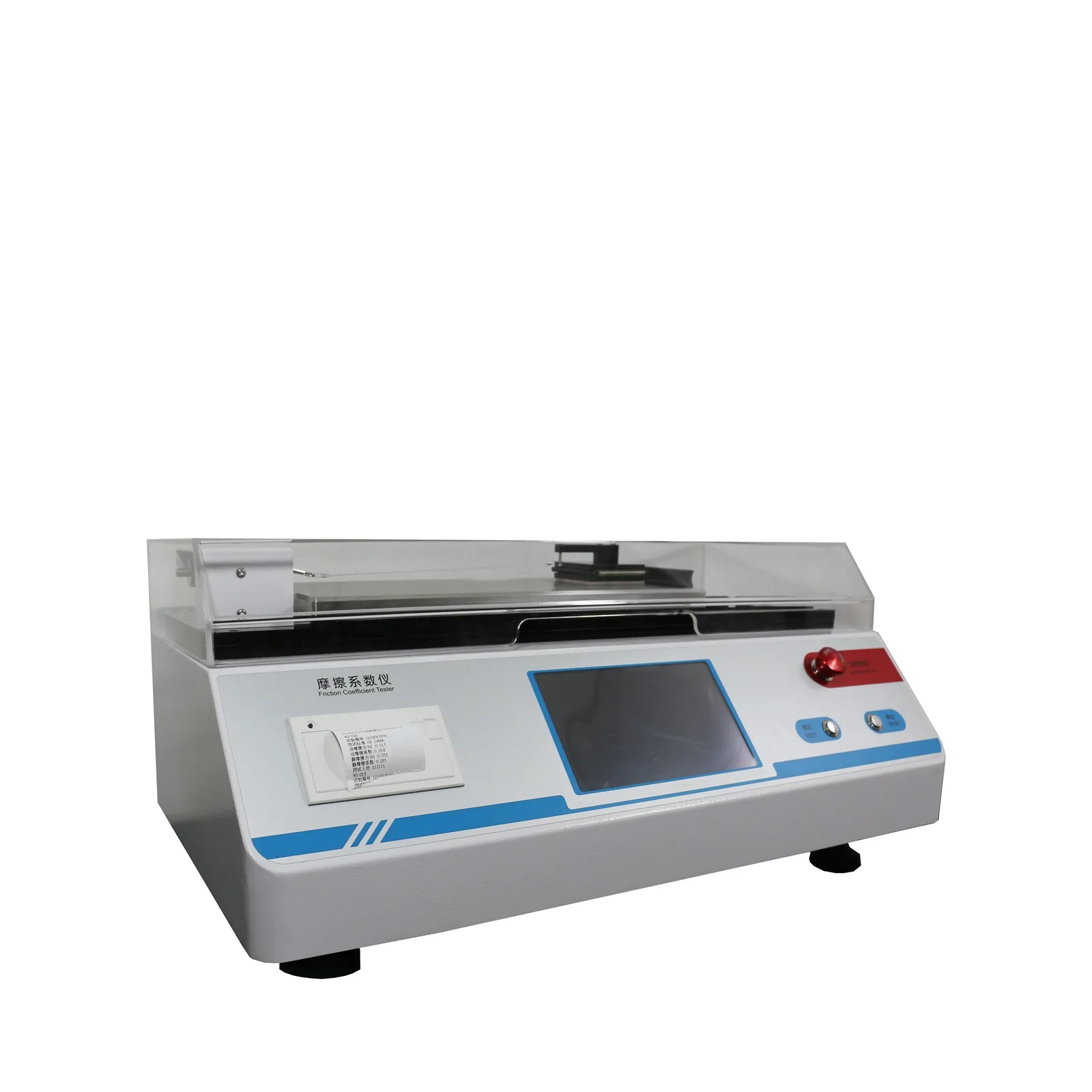
MXD-02A
Export Flagship
Our flagship export model. Base-plate-drag mechanism that keeps drive vibration away from the load cell, 8" HD touchscreen, sample thickness up to 10 mm, infinitely variable 0.1–500 mm/min speed.
Force
5 N (3/10/30 N opt.)
Display
8" Touch
Mechanism
Base-plate drag
Thickness
0–10 mm
 4 Standards Built-In
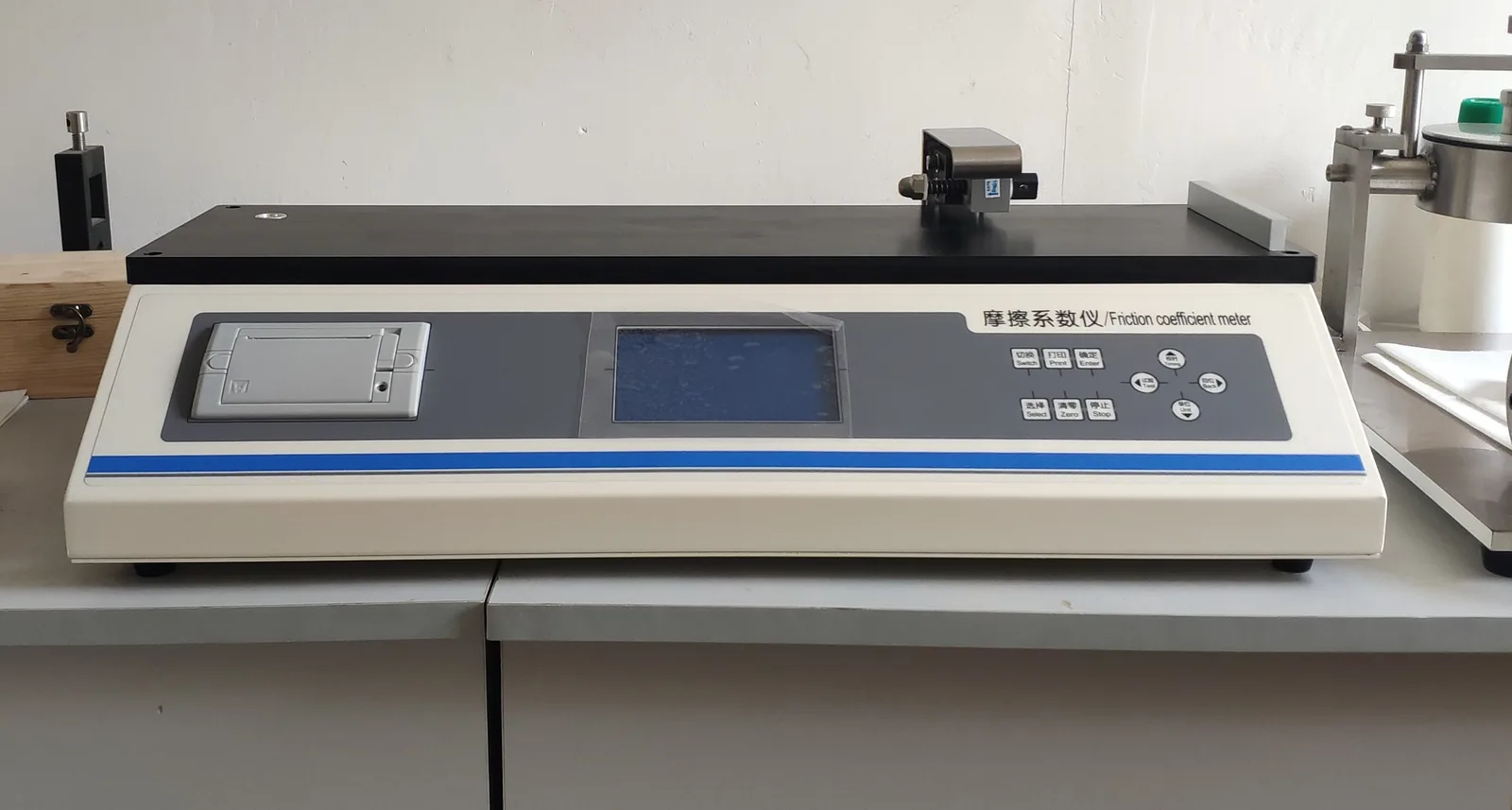
MXD-02
Multi-Standard Pro
All four standards (GB 10006 + ISO 8295 + ASTM D1894 + TAPPI T816) built in as one-touch presets, plus a custom mode. High-speed mode up to 1200 mm/min for paper industry GB/T 22895 testing.
Force
5 N (10/30 N opt.)
Standards
4 + custom
Max Speed
1200 mm/min
Display
5" LCD
 Best Value
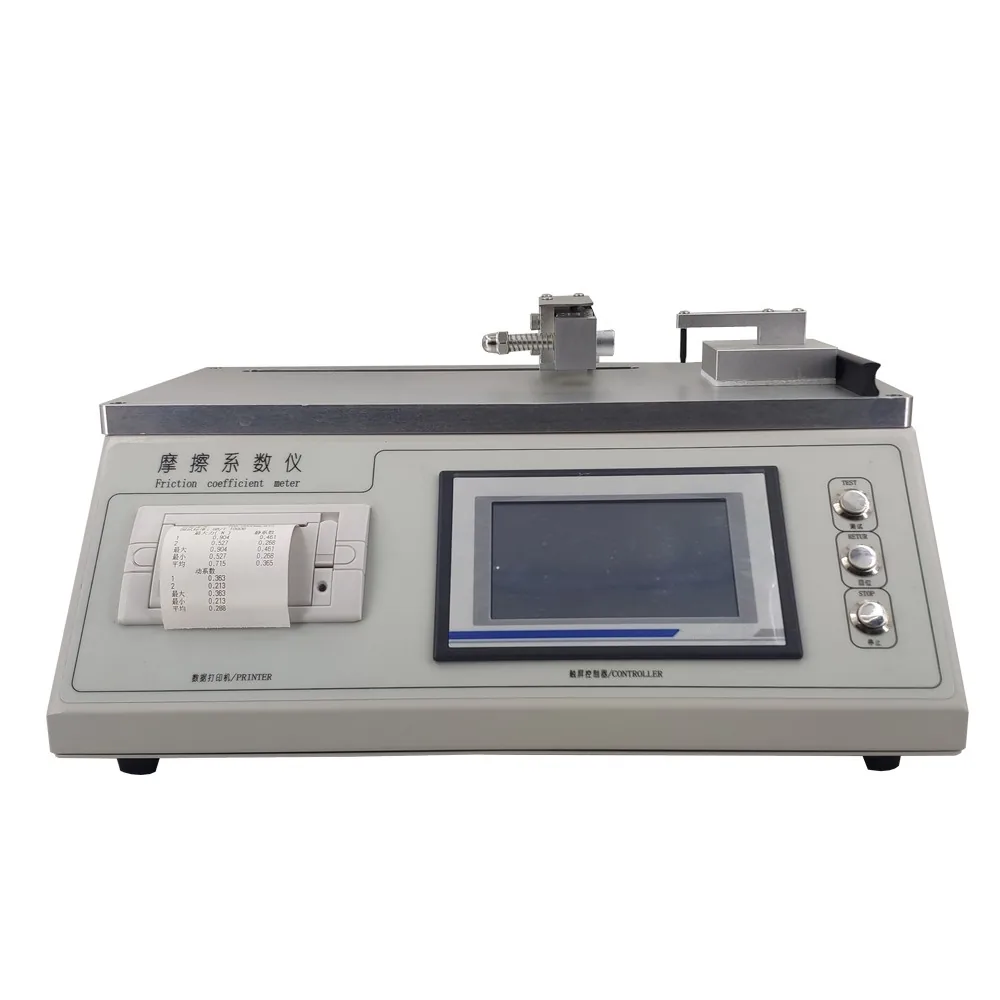
MXD-01A
Touchscreen Entry
The value pick — 5" color touchscreen UI, bilingual interface, wide-voltage power (90–240 V universal). GB 10006 and ASTM D1894 compliance for everyday packaging film QC.
Force
5 N (expandable)
Standards
GB + ASTM D1894
Display
5" Touch
Power
90–240 V universal
 Lowest Cost
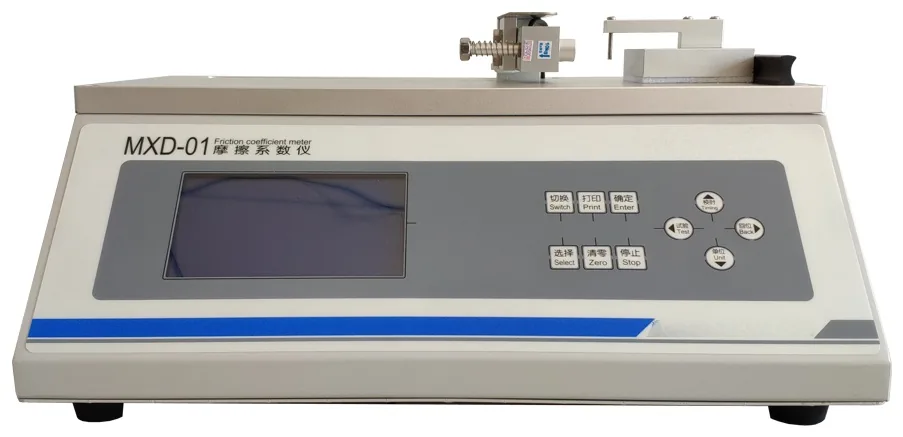
MXD-01
Button Entry
Lowest-cost entry-level model. 5" LCD with film-keypad controls, GB 10006 and ASTM D1894 compliance. Ideal for high-volume QC labs running a single standard with the lowest CapEx.
Force
5 N (expandable)
Standards
GB + ASTM D1894
Display
5" LCD
Weight
15 kg
Compare All 4 Models
Side-by-Side Model Specifications
Every KHT COF tester ships with the same metrology core (cantilever-beam load cell, 0.5% FS accuracy, ball-screw drive). Differences sit in mechanism, display, standards coverage, and physical envelope.
| Specification | MXD-01 | MXD-01A | MXD-02 | MXD-02A |
|---|---|---|---|---|
Force Measurement | ||||
| Force Range (Standard) | 5 N | 5 N | 5 N | 5 N |
| Optional Force Range | Expandable | Expandable | 10 / 30 N | 3 / 10 / 30 N |
| Force Accuracy | 0.5% FS | 0.5% FS | 0.5% FS | 0.5% FS |
| Resolution | 0.001 N | 0.001 N | 0.001 N | 0.001 N |
Test Parameters | ||||
| Test Speed (Preset) | 100 / 150 mm/min | 100 / 150 mm/min | 100 / 150 mm/min | 100 / 150 mm/min |
| Variable Speed Range | — | — | 1–1200 mm/min | 0.1–500 mm/min variable |
| Stroke Length | 70 / 150 mm | 70 / 150 mm | 70 / 150 mm (1–320 mm custom) | 70 / 150 mm (1–300 mm custom) |
| Sample Thickness | 0–6 mm | 0–6 mm | 0–6 mm | 0–10 mm |
Mechanism & UI | ||||
| Drive Mechanism | Sled drag | Sled drag | Sled drag | Base-plate drag |
| Display | 5" LCD + button keypad | 5" color touchscreen | 5" LCD + film keypad | 8" color touchscreen |
| Power Supply | AC 220 V 50 Hz | 90–240 V universal | AC 220 V 50 Hz | AC 110–220 V, 50/60 Hz |
| Bilingual (CN/EN) | Single language | Switchable | Single language | Switchable |
Sled Configuration | ||||
| Standard Sled | 200 g (63 × 63 mm) | 200 g (63 × 63 mm) | 200 g + 500 g | 200 g (500 g opt.) |
Standards Compliance | ||||
| GB 10006 (CN) | ✓ | ✓ | ✓ | ✓ |
| ASTM D1894 (US) | ✓ | ✓ | ✓ | ✓ |
| ISO 8295 (intl.) | — | — | ✓ (preset) | ✓ (preset) |
| TAPPI T816 (paper) | — | — | ✓ (preset) | ✓ (custom mode) |
| Custom / Non-Standard Mode | — | — | ✓ | ✓ |
Physical | ||||
| Dimensions (L × W × H) | 400 × 300 × 180 mm | 400 × 300 × 180 mm | 630 × 300 × 180 mm | 620 × 300 × 220 mm |
| Net Weight | ~15 kg | ~15 kg | ~20 kg | 35 kg |
Important Notes
- •All four models use the same cantilever-beam load cell with 0.5% FS accuracy class.
- •MXD-02A's base-plate-drag mechanism keeps the load cell stationary while the sample table moves — eliminating drive-induced vibration on the sensor (the leading source of error on entry-level COF testers).
- •MXD-02 supports the highest test speed (up to 1200 mm/min) for paper-industry GB/T 22895 testing where 20 mm/s is required.
- •Sled weight, sled geometry, and load-cell range can all be customized — talk to us about non-standard requirements.
- •All specifications verified against the latest ASTM, ISO, TAPPI, and GB standard revisions current as of unit ship date.
Need help selecting the right configuration? Our technical team is ready to assist.
Common DNA Across All 4 Models
All four KHT COF testers share a common metrology foundation that establishes their baseline measurement performance.
Force sensing: Each model uses a strain-gauge load cell in the cantilever-beam configuration. The standard range across all four models is 5 N, with 0.001 N digital resolution and 0.5% FS accuracy — a maximum error of 0.025 N at full scale. This accuracy class is sufficient to resolve meaningful differences in slip-agent treatment levels on plastic films and to distinguish surface coating effects on paper.
Sled geometry: All four models ship with the standard 200 g sled measuring 63 × 63 mm in contact area. This sled satisfies the geometric requirements of GB 10006 and ASTM D1894. The same sled design is used consistently across the lineup so comparative data generated on different models is instrument-compatible.
Test output: All four instruments include a built-in mini thermal printer that outputs a hard-copy test record at the end of each test. All four provide USB connectivity for data transfer to a PC.
Calibration and warranty: Every instrument ships with a calibration certificate traceable to national measurement standards. The warranty period is 24 months from date of shipment, covering parts and labor. Technical support is provided by KHT for the lifetime of the instrument.
Manufacturing: All four models are manufactured in KHT's Shandong, China facility and ship FOB Qingdao with a standard lead time of 3–5 weeks from confirmed purchase order. Export crating conforms to IPPC ISPM 15 phytosanitary requirements.
How to Choose: A Decision Tree
Work through the following questions in sequence to identify the correct model.
1. Do you need TAPPI T816 (paper and paperboard COF) or ISO 8295 as a factory preset? If yes: choose MXD-02 or MXD-02A. If no, continue.
2. Do you need infinitely variable test speed (any value from 0.1 to 500 mm/min), rather than two pre-set speeds? If yes: choose MXD-02A. If no, continue.
3. Do you need to test samples thicker than 6 mm (up to 10 mm)? If yes: choose MXD-02A. If no, continue.
4. Do you need an 8-inch touchscreen, or a base-plate-drag mechanism for improved vibration isolation on thin films? If yes: choose MXD-02A. If no, continue.
5. Do you need a bilingual (Chinese/English switchable) interface, or a power supply that runs on any voltage from 90 to 240 V without a transformer? If yes: choose MXD-01A. If no, continue.
6. Is lowest possible acquisition cost your sole remaining criterion? If yes: choose MXD-01 (specify language and voltage at order). If you want a future-proof entry-level unit: choose MXD-01A.
Summary by model: MXD-01 — lowest CapEx, two standards, button keypad, 220 V fixed. MXD-01A — entry-level touchscreen, two standards, universal voltage. MXD-02 — four standards, high-speed mode, sled-drag, 5-inch LCD. MXD-02A — export flagship, base-plate drag, 8-inch touch, variable speed, thick samples.
Mechanism Difference: Sled Drag vs Base-Plate Drag
Three of the four models — the MXD-01, MXD-01A, and MXD-02 — use the traditional sled-drag mechanism. In sled drag, the test platform (bed) is stationary. The drive motor pulls the sled across the surface of the specimen via a lead-screw mechanism and a connecting line. The load cell measures the lateral tension in the line as the sled slides. This is the mechanism described in ASTM D1894, ISO 8295, and TAPPI T816, and it is a proven, low-maintenance design that has been used in friction testing instruments for decades.
The MXD-02A uses a different geometry called base-plate drag (also termed moving-bed or inverted-drive). In this configuration, the sled is stationary and the test bed moves beneath it. The load cell is coupled directly to the sled rather than to the connecting line, placing the sensor in a more stable, vibration-isolated position. The drive mechanism does not introduce tension-line dynamics into the force measurement signal.
The practical consequence is signal quality on low-friction, thin films. When a sled is pulled by a connecting line, even small flexural vibrations in the line register as noise in the force trace — particularly at very low force levels (below 0.5 N) on slip-treated packaging films. The base-plate-drag geometry of the MXD-02A eliminates this noise source, producing a cleaner force-displacement curve at the cost of greater mechanical complexity.
For routine QC testing on films with COF values above 0.1, sled-drag instruments (MXD-01, MXD-01A, MXD-02) are fully adequate. The base-plate-drag advantage of the MXD-02A becomes significant for R&D work on highly slip-treated films or any application requiring very low-noise force data.
Standards Coverage by Model
The four KHT models differ significantly in which test standards are pre-configured as factory presets.
MXD-01 and MXD-01A: Both cover exactly two standards — GB 10006 (Chinese national standard for friction coefficient of plastic film and sheets, 100 mm/min) and ASTM D1894 (ASTM International, plastic film and sheeting, 150 mm/min). The 200 g sled and pre-set speeds are correct for both standards. Neither ISO 8295 nor TAPPI T816 is included.
MXD-02: Covers four standards as one-touch presets — GB 10006, ASTM D1894, ISO 8295 (ISO/European plastics film friction, 100 mm/min), and TAPPI T816 (paper and paperboard COF). A custom mode allows user-defined speed and stroke settings. A high-speed mode up to 1200 mm/min supports paper industry high-speed testing under GB/T 22895. The MXD-02 is the minimum model for any lab that must report ISO 8295 or TAPPI T816 results.
MXD-02A: Covers three standards as presets — GB 10006, ISO 8295, and ASTM D1894 — plus a custom mode for TAPPI T816 and user-defined methods. Note that TAPPI T816 is not a dedicated preset on the MXD-02A (it is on the MXD-02), but can be configured via the custom mode at the correct speed and sled weight. If TAPPI T816 as a one-touch preset is required, the MXD-02 is the appropriate choice.
In summary: MXD-01/01A — two standards. MXD-02 — four standards + custom, including TAPPI T816 preset. MXD-02A — three presets + custom mode (TAPPI T816 via custom).
Display and UI Differences
The four models span two display technologies and two interaction paradigms.
MXD-01: 5-inch LCD with film-keypad button controls. The operator uses physical membrane buttons to navigate menus. Language is fixed at order time (Chinese or English — not switchable afterward).
MXD-01A: 5-inch color touchscreen with bilingual Chinese/English interface. Language is switchable in the settings menu on the instrument without tools or firmware changes. Menu navigation is by touch. Real-time force curve is displayed in color during the test.
MXD-02: 5-inch LCD with button keypad controls. Similar interaction model to the MXD-01, but with a wider menu covering four standard presets, custom mode, and high-speed mode. This is a capable multi-standard instrument in a traditional button-keypad form factor.
MXD-02A: 8-inch HD color touchscreen, the largest and most capable display in the KHT lineup. The larger screen accommodates a more detailed real-time force-displacement curve view and a more complete test setup menu. The bilingual interface covers both Chinese and English. The 8-inch display is particularly useful for test setups requiring multiple parameter adjustments — speed, stroke, sled weight confirmation, standard selection — in a single workflow.
The display and UI differences reflect the intended operating environments: the MXD-01 and MXD-02 serve experienced operators in fixed-procedure production QC. The MXD-01A and MXD-02A serve users who benefit from touchscreen navigation, particularly in multilingual or export contexts.
When to Upgrade
Understanding the common upgrade triggers helps labs plan procurement without over-buying.
MXD-01 to MXD-01A: The trigger is almost always one of two things — the lab is being used in a non-220 V market and the step-down transformer is inconvenient or unreliable, or the instrument needs to be operated by users who work in both Chinese and English. Both are solved directly by the MXD-01A without any change in standards coverage.
MXD-01 or MXD-01A to MXD-02: The trigger is a change in testing scope that adds ISO 8295 or TAPPI T816 as required outputs. This commonly happens when a domestic film producer begins exporting to European buyers who reference ISO 8295 in their supplier quality agreements, or when a lab takes on paper and board testing for the first time. The MXD-02 is also the correct upgrade when a lab needs a high-speed mode (above 500 mm/min) for paper industry testing.
MXD-02 to MXD-02A: The triggers are more specific: (1) the lab needs sample thickness accommodation beyond 6 mm, (2) the lab requires infinitely variable test speed (research or non-standard method development), (3) the signal quality improvement of the base-plate-drag mechanism is needed for high-precision low-COF film research, or (4) the lab's export client base requires the 8-inch touchscreen form factor. The MXD-02A is also appropriate when a lab standardizes on a single export-facing flagship instrument and does not wish to maintain multiple models.
Note: Upgrading an existing model is not supported — each KHT model is a discrete instrument. Planning the right model from the start avoids replacement cost.
Customization Options
All four KHT models support a range of customization options that can be specified at order time.
Load cell range: The standard 5 N load cell is appropriate for plastic films, coated papers, and light textiles. Optional ranges — 3 N, 10 N and 30 N on the MXD-02A; 10 N and 30 N on the MXD-02 — are available for higher-friction materials such as rubber sheets, heavy textiles, and automotive surface materials. All optional load cell ranges maintain the same 0.5% FS accuracy class. Specify the required range at order; field-swapping load cells is possible but requires factory confirmation of calibration.
Sled selection: The standard 200 g sled (63 × 63 mm) is included with every model. A 500 g sled is optional; other sled masses can be made to order. Custom sled geometries — different contact areas, weights, or materials — can be engineered for non-standard applications such as medical device surface testing or irregular substrate geometries. Custom sleds are typically delivered within two weeks of order confirmation.
Fixtures and accessories: Application-specific fixtures are available for rubber samples (clamp to hold compliant specimens flat), textiles (template for consistent specimen cutting), and medical device testing (custom contact geometries for catheters, guidewires, or syringe plungers).
Stroke and speed: Both stroke lengths (70 mm and 150 mm) are selectable on all four models. Speed pre-sets are fixed on MXD-01, MXD-01A, and MXD-02; the MXD-02A provides fully variable speed from 0.1 to 500 mm/min.
Contact KHT at info@coefficientoffrictiontester.co to discuss custom requirements before placing an order.
Also From KHT: XLW-DG for Catheters and Guidewires
The four MXD models above all use the horizontal sled method for flat film, sheet, and board samples. KHT also manufactures the XLW-DG Catheter & Guidewire Friction Tester, a separate instrument built for round, flexible medical devices — particularly hydrophilic-coated catheters and guidewires. It uses a clamp-and-pull (pinch test) method with an integrated thermostatic water bath, corresponding to the industry's established wet-friction test approach and to China's YY/T 1536-2017 and T/CAMDI 021-2019. If your samples are catheters, guidewires, or similar tubular devices rather than flat material, see the XLW-DG product page rather than the MXD comparison above.
Frequently Asked Questions
Not Sure Which Model Is Right for You?
Tell us your application, target standards, and budget — we'll recommend the right KHT COF tester within 24 hours.